
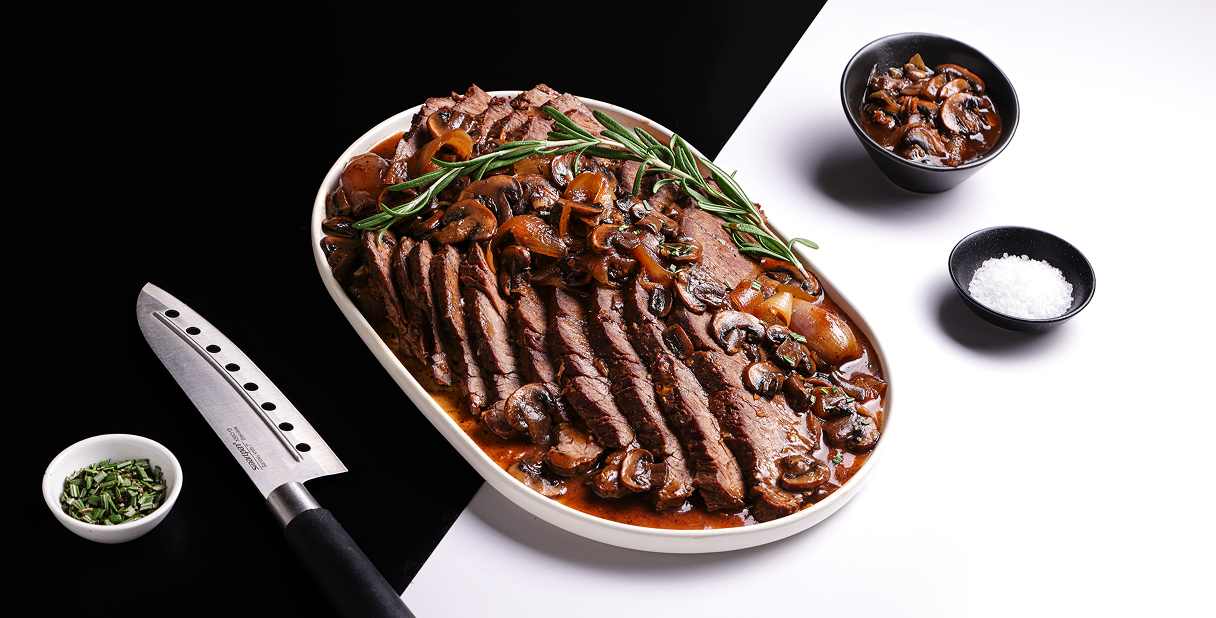
Classic French Roast with
Rich Mushroom & Onion Sauce

Two Paths to
Great Flavor
The Simple Approach is for those who want smart shortcuts without sacrificing flavor. They want to create impressive meals without spending hours in the kitchen. Instead of making stock from scratch, cooks can use ready-made vegetable or beef stock, or even a simple soup mix with water. Vegetables will then go straight into the pan with minimal prep, keeping things quick and easy while still delivering an elevated, satisfying result. Even with these shortcuts, you’ll achieve rich, layered flavors and results that rival a chef’s touch.
The Chef’s Method is for cooks who want to embrace true French-inspired techniques. Vegetables are seared or roasted to build a deep, flavorful homemade broth, which becomes the base for cooking the meat. The broth is then carefully strained to create a unique sauce tailored to each cut. Even the finishing touches are chef-driven, like wrapping the warm meat tightly in layers of plastic wrap to give it a refined, restaurant-worthy presentation.
This dual approach makes the recipes flexible, making it ideal for anyone who wants to cook like a chef at home, yet equally practical for busy families who want the same delicious results with less effort.
Tools of the trade
Cooking meat to perfection isn’t just about the cut or the recipe, it’s also about having the right tools at your side. The right utensils and gadgets make the process easier, and more precise, ensuring every roast, steak, or braise comes out just the way you want it. Here are some essentials every cook should keep in their kitchen.

Ensures perfect doneness without guesswork.

Clean, precise slicing and trimming.

Keeps knives sharp for safe, precise cutting and trimming.

Makes carving large roasts effortless.

Prevents sticking, doubles as a cartouche (paper lid) to retain moisture.

Secures roasts and stuffed meats for even cooking.

For trimming fat, cutting poultry, or snipping twine.

Turn or transfer meat without piercing or losing juices.

For spreading a glaze or pan juices over meat to keep it flavorful and moist.

Keeps track of cooking and resting times accurately.

Strains pan sauces for smooth, silky results.
Ingredients
Seared Vegetable Base:
2 tablespoons beef fat or oil (beef fat adds extra flavor)
½ leek, finely sliced
2 shallots or ½ red onion, finely diced
1 teaspoon salt
5 cloves garlic, minced or crushed
1½ carrots, finely diced
1 parsnip, finely diced
½ head celery, finely sliced
½ zucchini, finely diced
½ cup tomato paste
1 tablespoon brown sugar (or white sugar)
2 cups vegetable stock (recipe below)
½ cup red wine
The Meat:
5 lbs. French roast
1 tablespoon kosher salt
½ tablespoon butchers cut black pepper
3-4 tablespoons oil
2 onions, sliced
4 cloves garlic, minced or crushed
1 8 oz pkg fresh portobello mushrooms, sliced
¼ cup brown sugar
2 tsp salt
2 cup water or vegetable stock
2 tablespoon cornstarch dissolved in 2 tablespoons water
Mushroom & Onion Sauce:
2 tablespoons beef fat or oil
2 onions, sliced
4 cloves garlic, crushed
14 oz. portobello mushrooms, sliced
2 tablespoons brown sugar
Strained sauce from roast
1 tablespoon cornstarch dissolved in 2 tablespoons water (slurry)
Directions
Make the Seared Vegetable Base:
- Heat beef fat in a pan over medium heat, and add leek, shallots and salt; cook for 10 minutes until soft and lightly golden.
- Add garlic, cook for 1 minute, then stir in carrot, parsnip, celery, zucchini and cook for 5 minutes.
- Mix in tomato paste and sugar, stirring for 2-3 minutes until paste darkens to a brick color.
- Add the vegetable stock and wine and stir to combine, simmering for 5 minutes until slightly thickened.
Cook The Meat:
- Preheat the oven to 275°F. Season the meat with salt and pepper on all sides.
- Heat a large frying pan over high heat, add the oil, and sear the meat for 3-5 minutes per side, until the meat has a golden brown crust on both sides. (This helps build flavor.) Transfer the meat to a 9×13 pan.
- Add 1-2 tablespoons of oil to the hot frying pan. Add the onions and scrape up the brown bits from the bottom of the pan (this is called deglazing the pan.)
- Lower the heat to medium and saute the onions for 10 minutes, stirring occasionally until the onions are soft and fragrant.
- Add the minced garlic and continue to saute for 5 minutes. Add the mushrooms and saute for 6-8 minutes. Add the brown sugar, salt and water and bring to a boil. Pour the sauce over the meat.
- Place a sheet of parchment paper on top of the meat. (This helps the meat steam well.) Cover the pan tightly with two layers of foil, crimping the foil edges together with the parchment to seal.
- Bake for 3 hours or until the internal temperature of the meat reaches 200°-205°F using a meat thermometer. (A meat thermometer is highly recommended when cooking any meat.)
- Remove the meat from the oven, open the foil slightly, and allow it to cool down. Once cooled, remove the meat from the sauce and wrap it with silver foil or Saran wrap. Transfer the sauce to a container.
- Refrigerate the meat overnight, and use a sharp knife to slice the meat. Once cut, arrange the slices in a 9×13 pan. Pour the sauce over the sliced meat, cover the pan and rewarm in the oven before serving.
- Optional, for a thicker sauce: Before rewarming, bring the sauce to a boil in a pot. Add the dissolved corn starch and cook for 1-2 minutes until thickened. Then pour it over the meat and rewarm in the oven.
Make the Mushroom & Onion Sauce:
- Heat pan over medium heat, and add fat or oil.
- Add onions and garlic to pan and cook for 8-10 minutes. Add mushrooms, cook for an additional 6-8 minutes.
- Stir in brown sugar and cook for 1 minute, then add strained meat sauce and simmer 3-4 minutes.
- Pour in cornstarch slurry, stirring for 1 minute as it thickens.
- Place sliced meat in a pan with the sauce, cover with foil and warm in the oven at 300°F for 30 minutes.
Vegetable Stock: (Sidebar)
- Homemade: Use the same vegetables listed in the seared vegetable base, (you can also include the leaves of the celery and leek) and cut into large chunks. Place in a pot, cover with water, and simmer for 45-60 minutes. Strain. It will yield at least 3 cups.
- Store-bought vegetable stock: 3 cups.
- Water + soup mix: Mix 3 cups water with 3 tablespoons vegetable soup mix.
Ingredients
Seared Vegetable Base:
2 tablespoons beef fat or oil (beef fat adds extra flavor)
½ leek, finely sliced
2 shallots or ½ red onion, finely diced
1 teaspoon salt
5 cloves garlic, minced or crushed
1½ carrots, finely diced
1 parsnip, finely diced
½ head celery, finely sliced
½ zucchini, finely diced
½ cup tomato paste
1 tablespoon brown sugar (or white sugar)
2 cups vegetable stock (recipe below)
½ cup red wine
The Meat:
3-6 lbs. Brick roast
2-3 tablespoons beef fat or oil
1 tablespoon coarse salt
½ tablespoon coarse black pepper
1 cup vegetable stock (for deglazing)
Prepared vegetable base sauce (recipe above)
Mushroom & Onion Sauce:
2 tablespoons beef fat or oil
2 onions, sliced
4 cloves garlic, crushed
14 oz. portobello mushrooms, sliced
2 tablespoons brown sugar
Strained sauce from roast
1 tablespoon cornstarch dissolved in 2 tablespoons water (slurry)
Directions
Make the Seared Vegetable Base:
- Heat beef fat in a pan over medium heat, and add leek, shallots and salt; cook for 10 minutes until soft and lightly golden.
- Add garlic, cook for 1 minute, then stir in carrot, parsnip, celery, zucchini and cook for 5 minutes.
- Mix in tomato paste and sugar, stirring for 2-3 minutes until paste darkens to a brick color.
- Add the vegetable stock and wine and stir to combine, simmering for 5 minutes until slightly thickened.
Cook The Meat:
- Preheat oven to 275°F and line a small roasting pan with parchment paper.
- Place the prepared vegetable base in the pan.
- Season the meat with salt and pepper. Heat a large frying pan over high heat, add the beef fat or oil, and sear the meat for 3-5 minutes per side until it has a golden brown crust on both sides. Transfer the meat to the pan on top of the vegetable base.
- Add 1 cup vegetable stock to the hot skillet, and scrape up all the brown bits from the bottom of the pan (this is called deglazing the pan.) Pour the liquid into the pan with the meat. It should reach about ⅓ of the way up the roast; add more vegetable stock if needed.
- Wet a sheet of parchment paper and place it directly on top of the meat. Cover the pan tightly with two layers of foil, crimping the foil edges together with the parchment to seal.
- Bake until internal temperature reaches 200-205°F using a meat thermometer, or until a fork can easily be inserted into the meat. See approximate cooking times below.
- Remove the meat from the oven, open the foil slightly, and allow it to cool down. While still warm, wrap the meat tightly in plastic wrap so it retains its shape.
- Strain the liquid from the pan, discarding the vegetables; reserve the strained liquid for the Mushroom and Onion Sauce.
- Refrigerate the meat overnight, then slice the meat while cold with a sharp knife for clean, even portions.
Approximate cooking times for Brick Roast are as follows based on the weight of the roast:
- 3–4 lbs: 3½–4 hours
- 4–5 lbs: 4–4½ hours
- 5–6 lbs: 4½–5 hours
Make the Mushroom & Onion Sauce:
2 tablespoons beef fat or oil
2 onions, sliced
4 cloves garlic, crushed
14 oz. portobello mushrooms, sliced
2 tablespoons brown sugar
Strained sauce from roast
1 tablespoon cornstarch dissolved in 2 tablespoons water (slurry)
Vegetable Stock: (Sidebar)
- Homemade: Use the same vegetables listed in the seared vegetable base, (you can also include the leaves of the celery and leek) and cut into large chunks. Place in a pot, cover with water, and simmer for 45-60 minutes. Strain. It will yield at least 3 cups.
- Store-bought vegetable stock: 3 cups.
- Water + soup mix: Mix 3 cups water with 3 tablespoons vegetable soup mix.
Yossi’s Tips
Laying vegetables in the pan under the roast before cooking acts as a natural rack, lifting the meat so it doesn’t burn on the bottom of the pan. The vegetables will soften and caramelize and release rich flavors into the liquid.
Two Paths to
Great Flavor
The Simple Approach is for those who want smart shortcuts without sacrificing flavor. They want to create impressive meals without spending hours in the kitchen. Instead of making stock from scratch, cooks can use ready-made vegetable or beef stock, or even a simple soup mix with water. Vegetables will then go straight into the pan with minimal prep, keeping things quick and easy while still delivering an elevated, satisfying result. Even with these shortcuts, you’ll achieve rich, layered flavors and results that rival a chef’s touch.
The Chef’s Method is for cooks who want to embrace true French-inspired techniques. Vegetables are seared or roasted to build a deep, flavorful homemade broth, which becomes the base for cooking the meat. The broth is then carefully strained to create a unique sauce tailored to each cut. Even the finishing touches are chef-driven, like wrapping the warm meat tightly in layers of plastic wrap to give it a refined, restaurant-worthy presentation.
This dual approach makes the recipes flexible, making it ideal for anyone who wants to cook like a chef at home, yet equally practical for busy families who want the same delicious results with less effort.
Tools of the trade
Cooking meat to perfection isn’t just about the cut or the recipe, it’s also about having the right tools at your side. The right utensils and gadgets make the process easier, and more precise, ensuring every roast, steak, or braise comes out just the way you want it. Here are some essentials every cook should keep in their kitchen.
Meat Thermometer:
Ensures perfect doneness without guesswork.
Sharp Chef’s Knife:
Clean, precise slicing and trimming.
Knife Sharpener:
Keeps knives sharp for safe, precise cutting and trimming.
Electric Knife:
Makes carving large roasts effortless.

Parchment Paper:
Prevents sticking, doubles as a cartouche (paper lid) to retain moisture.
Kitchen Twine:
Secures roasts and stuffed meats for even cooking.
Kitchen Shears:
For trimming fat, cutting poultry, or snipping twine.
Heavy-Duty Tongs:
Turn or transfer meat without piercing or losing juices.
Basting Brush:
For spreading a glaze or pan juices over meat to keep it moist.
Digital Kitchen Timer:
Keeps track of cooking and resting times accurately.
Fine Mesh Strainer:
Strains pan sauces for smooth, silky results.
Yossi’s Tips
Laying vegetables in the pan under the roast before cooking acts as a natural rack, lifting the meat so it doesn’t burn on the bottom of the pan. The vegetables will soften and caramelize and release rich flavors into the liquid.
